
AI Cybersecurity: Power, Pitfalls, and Governance
AI enhanced security tools analyze massive data in real time to spot hidden threats and predict attacks, far beyond what static rules allow. Organizations gain faster detection and response automated triage and SOAR playbooks can cut breach costs by millions and shrink incident timelines by months. However, unchecked AI can foster blind spots: over trusting opaque models leads to fatigue and false confidence. Leaders must pair AI with strong governance, identity centric controls, and human oversight to turn it into a true force multiplier.
The adoption of AI in cybersecurity has surged as businesses grapple with exploding attack surfaces and ever‑faster threats. The traditional network perimeter has vanished, cloud workloads, mobile users, and third party APIs create a nebulous digital environment ripe for attack. Meanwhile, adversaries use machine‑speed tools and generative AI to craft polymorphic malware and realistic phishing lures. Static signature scanners simply cannot keep up. This arms race forces defenders to apply AI and machine learning ML to sift through vast logs and network flows for anomalies. However, boards and C‑suites must understand that AI is an accelerator, not a silver bullet.
What AI Powered Cybersecurity Actually Means
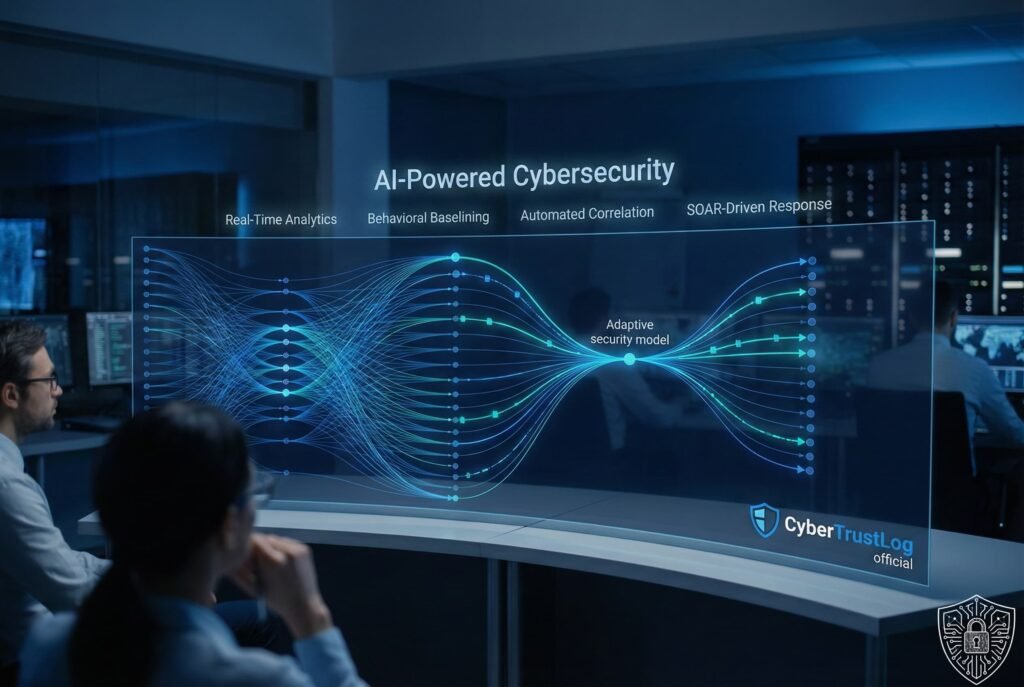
AI powered often becomes a buzzword, but at its core it refers to systems that learn from data rather than rely solely on fixed rules. In practice this usually involves machine learning ML models that ingest security data file hashes, network flows, user events and continuously improve their detection logic. Key capabilities include real time data processing analyzing events as they occur, pattern recognition across data sources, behavioral baselining to spot anomalies, and automated correlation of alerts. For example:
- Real time analytics: ML engines monitor live logs and network traffic, spotting new attack signatures or bursts of scanning that static tools miss.
- Behavioral baselines: Systems build profiles of normal user and device activity, any deviation impossible logins, unusual data transfers are flagged.
- Automated triage and orchestration: AI correlates low level alerts into prioritized incidents and can trigger Security Orchestration, Automation and Response SOAR workflows. Well defined responses isolating a compromised host, revoking a credential can execute instantly without waiting for a human.
These AI techniques go far beyond legacy signature based tools by adapting to new threats. However, the term is often misunderstood or overpromoted. Not every product labeled AI truly uses self learning models, some simply automate old rules. Leaders must verify that solutions continuously learn from data and provide explainable insight, lest they inherit hidden failures.
Where AI Is Making a Real Security Impact

AI is already transforming several core security functions for modern enterprises. Below are key areas where machine learning and automation add real value:
- Threat detection at scale: AI systems can process millions of events per second, correlating network logs, endpoint telemetry, and cloud alerts to identify subtle attacks. They excel at spotting polymorphic or zero day malware by behavior rather than by signature. For example, an AI model won’t care if a ransomware binary is encrypted with a novel key it will flag the mass file encryption behavior. Similarly, anomaly detection can catch lateral movement: an unusual series of logins across servers may indicate an APT. Studies note that these platforms detect threats in seconds that would take humans hours. This leads to much earlier detection of breaches one report cited a 34% reduction in dwell time using AI driven behavioral analysis.
- Identity and account abuse prevention: With stolen credentials now a top breach vector 30% of incidents in 2023, AI driven identity analytics are crucial. Machine learning profiles each user and device when a login or API access deviates from the baseline, it raises an alert. For instance, if a database admin account is used at 3 AM from an unfamiliar country, or if an API key spikes data access unexpectedly, behavioral AI will flag it. This user/entity behavior analytics UEBA approach catches insider threats and account takeovers that rule based systems miss. As one IAM expert explains, behavioral analytics look at a collective pattern of actions even if each step seems normal in isolation and detect the unusual sequence. In practice this means AI can detect a compromised account before damage: IBM’s 2024 report noted that attacks using valid credentials surged 71% year-over-year, underscoring how crucial anomaly detection is. These identity first methods align with Zero Trust architecture principles, continuously re-evaluating trust on every request.
- SOC efficiency and automated response: AI is a force multiplier in the Security Operations Center. By ingesting alerts from SIEMs, EDR, and cloud monitors, intelligent platforms automatically triage thousands of low priority logs into a few critical incidents. For example, AI correlates multiple indicators file hashes, IP addresses, user IDs to present a unified attack narrative to analysts. High confidence threats trigger automated workflows: a SOAR system might instantly isolate an infected endpoint and block malicious IPs without human intervention. The impact is dramatic. IBM reports that organizations extensively using AI and automation saw breach costs fall by ~$1.9M on average and response timelines shrink by 80 days. In short, AI reduces alert fatigue by filtering out noise, enabling teams to focus on genuine threats and investigation. 24/7 AI monitoring also ensures no gap in coverage automated hunting tools can detect attacks even during off hours. Overall, AI driven SOC tools accelerate detection, response, and threat hunting, turning raw data into actionable protection.
Where AI Security Commonly Breaks Down

Even with its strengths, AI can fail without the right controls. Security leaders should be aware of several common breakdowns:
- Over reliance on automation: Giving tools too much autonomy creates a false sense of security. AI is not infallible novel threats or subtle tactics may slip past models trained on past data. Research finds analysts often suffer fatigue and may start ignoring alerts if AI outputs many false positives. Worse, teams might copy and paste AI recommendations blind mimicry without scrutiny, missing contextual cues. In one survey 38% of organizations felt no more confident in security despite new tools. Leaders must avoid thinking about it and forget it. AI should augment human expertise, not replace it. Maintaining skilled analysts to review AI findings is essential. Studies show overconfidence in AI can erode basic security hygiene if left unchecked.
- Identity and visibility gaps: AI can only protect what it can see. Many environments have identity shadow: dozens of service accounts, forgotten cloud credentials, or unmanaged IoT devices that slip outside monitoring. If an attacker compromises an unnoticed account or an employee uses an unsanctioned AI tool, the system is blind to that foothold. In fact, analysts report rampant shadow AI usage: one study found ~47% of employees using generative AI via personal accounts, often exposing data outside IT control. Such unmonitored tools introduce blind spots. Likewise, if critical cloud API keys or machine identities aren’t fed into the AI system, anomalies in those channels go undetected. Gartner warns that by 2030, over 40% of enterprises will suffer incidents due to ungoverned AI tools. In short, lack of comprehensive asset and identity inventory human or machine means gaps in AI analysis, letting threats through.
- Alert fatigue and blind trust: Paradoxically, poorly implemented AI can still overwhelm. A less mature AI model may flood analysts with non critical alerts that seem urgent, contributing to fatigue. Security staff who blindly trust all AI alerts can miss when it’s wrong automation bias is a real problem. Additionally, adversaries are developing techniques for adversarial attacks to fool AI models. For example, slight changes to malware code can evade a trained ML classifier. Without human oversight, these blind spots create risk. Human experts emphasize that AI should not be treated as an oracle, teams must validate suspicious detections and remain skeptical of automated verdicts.
Even smart AI has blind spots. Over trusting automation or missing shadow identities like unsanctioned AI tools opens serious gaps in protection.
The Business Risk of a Poor AI Security Strategy
Neglecting the limits of AI in security can expose a business to major risks:
- False confidence in security posture: Leaders may assume that buying an AI driven product solves problems. This can lead to complacency. In reality, automation alone doesn’t fix root causes. As a result, companies can be caught off guard. For instance, a recent report found only ~40% of organizations using advanced tools felt confident in their overall security. Overreliance means critical risks like misconfigurations or rogue accounts slip by undetected. In essence, overconfidence in technology can give a false sense of safety and mask true vulnerabilities.
- Unchecked Shadow AI: Permitting or ignoring employees’ use of unsanctioned AI tools is a ticking time bomb. Shadow AI mirrors the classic shadow IT problem, sensitive data can leak or become vulnerable outside corporate controls. One analysis showed employees inadvertently sent sensitive files to public AI services hundreds of times per month on average. Companies that lack policies or monitoring for AI usage will face data breaches or compliance violations. This risk directly erodes ROI on security breaches involving shadow AI that were reported to cost ~$670K more on average.
- Account takeover escalation: Attackers increasingly exploit stolen credentials to move laterally. Without strong identity analytics, a single compromised account can turn into a full blown breach. IBM notes that credential theft has become as common as phishing, comprising ~30% of incidents. Once inside, adversaries may escalate privileges and exfiltrate data quietly. Inadequate AI that misses these anomalies means a breach can quickly cascade. In short, missing the early warning signs of account misuse exposes the entire organization.
How Mature Organizations Use AI Security Effectively

Leading companies recognize that AI in security succeeds only with proper guardrails:
- Implement governance, not bans: Instead of outright banning AI, mature teams set clear policies and oversight. They define which tools and data are allowed, and log all AI usage for audit. Industry frameworks like NIST’s AI Risk Management Framework are adopted to ensure accountability. For example, CISOs create AI risk councils and acceptable use policies for generative tools. They also require data handling and privacy controls on any AI service. This reduces shadow AI risk by controlling how AI can interact with corporate data.
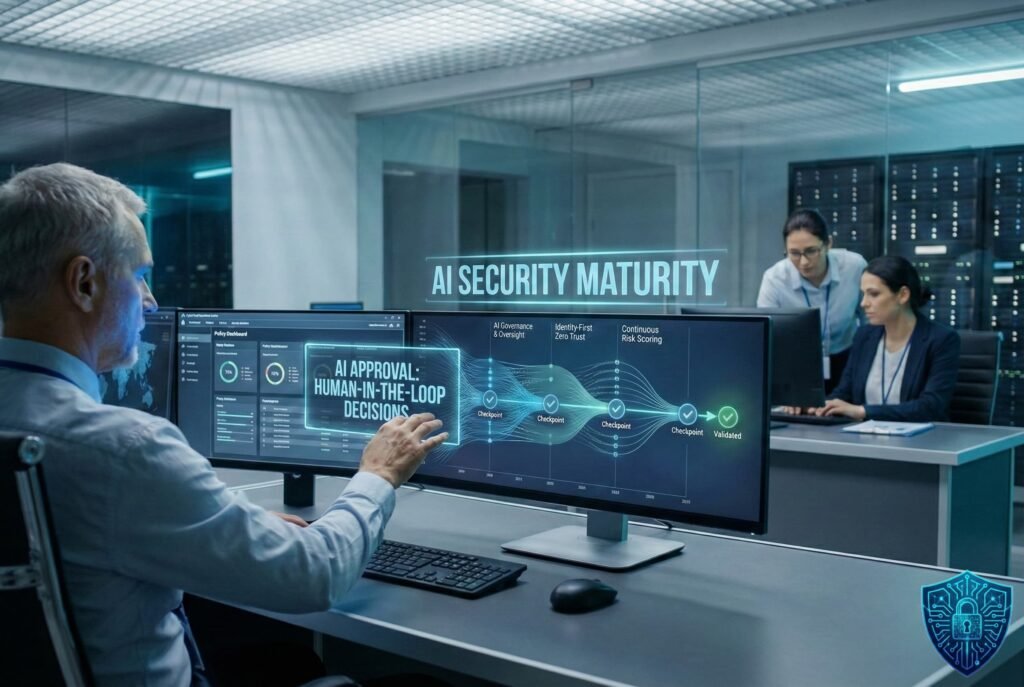
- Human in the loop controls: AI outputs are treated as input, not final verdicts. Security analysts routinely verify AI alerts before acting. Many organizations require human approval for sensitive response actions. This human‑machine teaming combines AI speed with human judgment. It also keeps staff skilled, Gartner notes that over‑dependence on AI without human skill refresh leads to loss of institutional knowledge. By maintaining oversight, teams catch AI blind spots and avoid automation bias.
- Identity first security posture: Top tier organizations integrate AI into a Zero Trust, identity centric model. They inventory all user and machine identities and continuously score their risk. AI is applied to every authentication and access event. For example, if an AI agent or cloud service identity suddenly behaves out of pattern, the system enforces step up controls. This just in time, just enough access approach ensures that even if an attacker has a valid credential, they cannot move freely without triggering alarms. In practice, firms fuse AI insights into their identity management: behavioral risk scores from AI can instantly trigger MFA or block actions for high risk sessions. This combination of AI with granular identity controls traps lateral movements and insider threats.
By balancing technology with process emphasizing AI governance and continuous validation these organizations turn AI from a liability into a strategic asset.
What This Means for Business Leaders
For executives, the message is clear: treat AI in security as part of a broader strategy, not a checkbox purchase. Success comes from architecting your defense around AI, not simply acquiring AI labeled products. This means investing in data collection, identity management, and skilled analysts who can interpret AI findings. One strategic insight: security should be viewed as an enabler of business, not a roadblock. Use AI to automate routine tasks freeing experts to hunt real threats, and let faster incident handling support innovation rather than fear it.
Leaders should align AI efforts with business risk. Define clear metrics mean time to detect/respond, breach cost reduction to measure AI impact. They must also foster a culture of vigilance: require regular review of AI performance, encourage reporting of near misses, and avoid turning over decision making entirely to machines. In practice, this might involve forming cross functional AI risk committees involving IT, legal, and business to govern AI use in the enterprise.
AI can greatly enhance cybersecurity, but only if implemented thoughtfully. Companies that pair AI capabilities with strong identity governance, human oversight, and continuous testing will build a resilient, adaptive defense. Those that naively treat AI tools as magic solutions risk giving attackers the upper hand. The strategic prize for leaders is secure innovation by leveraging AI responsibly, security becomes a business enabler that scales trust in the digital future.
FAQs
How does AI based security differ from traditional tools?
AI powered systems use machine learning and analytics to spot complex patterns and anomalies in data. Unlike rule based defenses, they learn from examples malware samples, user behavior and adapt to new threats. In practice this means AI tools can identify unknown threats through behavior, whereas traditional tools rely on known signatures or static rules.
What operational benefits can we expect from AI in cybersecurity?
AI drives faster detection and response. For example, machine learning can analyze logs and network traffic in seconds, flagging incidents before they escalate. Automation also reduces manual work: SOAR playbooks can contain breaches automatically, and continuous monitoring gives 24/7 coverage. Companies report significantly lower breach costs and faster remediation when using AI and automation.
What limitations or risks should we watch out for?
AI models have blind spots. They may miss novel attack types or generate false positives. Organizations must guard against automation bias and never assume AI is infallible. Another risk is unsupervised AI use: employees using unauthorized AI tools can leak data. Proper governance and human validation are critical to mitigate these risks.
Should we ban AI tools or do something else?
Rather than banning AI outright, implement clear policies and oversight. Bans often fail and push tools underground. Instead, define approved AI platforms with privacy/security controls and audit their use. Gartner suggests creating enterprise wide rules and regular audits for AI tool usage. Training and awareness are also vital: ensure teams know how to safely use AI and how to spot suspicious outputs.
How does AI fit into a Zero Trust framework?
AI is a key enabler of Zero Trust. It continuously evaluates risk for every access request checking user behavior, device health, and context. If risk rises, AI can trigger extra verification like MFA or restrict access. In effect, AI provides the always verify engine behind Zero Trust, making policies adaptive rather than static.
Will AI replace our security analysts?
No AI is a force multiplier, not a replacement. It handles scale and speed, but human expertise is still essential for judgment and context. Analysts should work with AI: verifying its alerts, investigating complex incidents, and refining models. In fact, experts warn that over reliance on AI can erode human skills over time. The best teams use AI to automate the mundane, while humans focus on strategy and sophisticated threats.
How can we measure if our AI security tools are working?
Track metrics like mean time to detect/response, rate of false positives, and percentage of threats caught. Benchmark these against the period before AI deployment. Effective AI should reduce breach dwell time and free analyst bandwidth for hunting. Also, conduct regular red team exercises and penetration tests to validate AI detections and adjust models as needed.

AI driven cybersecurity is not a magic switch, but it is a paradigm shift. By moving from static defenses to dynamic, data‑driven ones, organizations gain predictive resilience in a hyper‑connected world. The strategic advantage comes when AI is treated as a trusted partner constantly tuned by human expertise and governed by rigorous policies. In that scenario, AI makes security an enabler of growth rather than a bottleneck, helping businesses scale safely even as attackers leverage the same technology.
About the Author: Mohammed Khalil is a Cybersecurity Architect at DeepStrike and the owner of CyberTrustLog. Specializing in advanced penetration testing and offensive security operations, he holds certifications including CISSP, OSCP, and OSWE. Mohammed has led numerous red team engagements for Fortune 500 companies, focusing on cloud security, application vulnerabilities, and adversary emulation. His work involves dissecting complex attack chains and developing resilient defense strategies for clients in the finance, healthcare, and technology sectors.